Gospel Songwriting blog
A Guide to Creating Your Message with Soul and Strategy
4/1/202613 min read
Gospel Songwriting: A Guide to Creating Your Message with Soul and Strategy
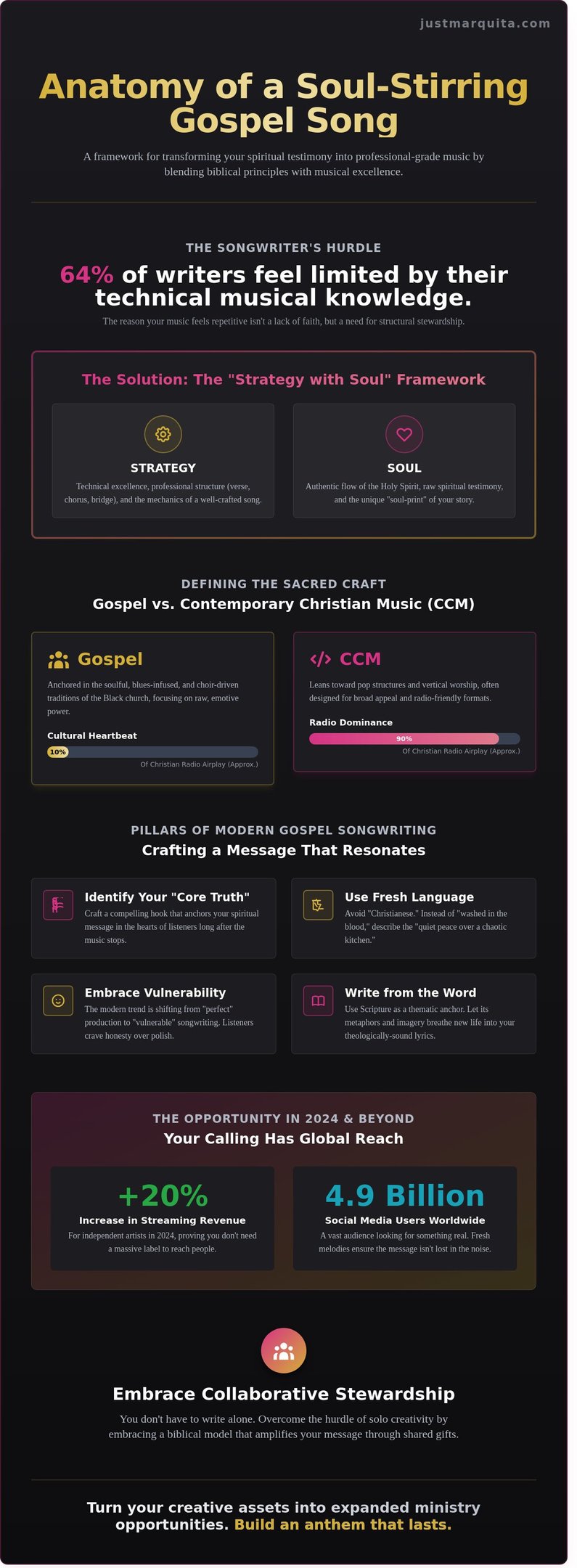
What if the reason your worship music feels repetitive isn't a lack of faith, but a lack of structural stewardship? You've likely spent hours at your piano or with a notebook, only to feel that your lyrics fall into the same predictable patterns. It's a common struggle; in a 2023 survey of independent creators, 64% of writers admitted they felt limited by their technical musical knowledge. You want your art to reflect the depth of your walk with God, yet the loud hustle of the music industry often drowns out the quiet peace of your ministry. You deserve a creative process that honors both your spirit and your craft.
I believe that gospel songwriting is a sacred responsibility that requires both heart and high-level strategy. This guide will teach you how to transform your raw spiritual testimony into professional-grade music by blending biblical principles with musical excellence. We'll break down the specific mechanics of verse, chorus, and bridge structures so your message carries the weight it deserves. By the end, you'll have a clear path to professional production and a finished song that feels authentic to your unique calling. Let's move toward clarity and build an anthem that lasts.
Key Takeaways
Discover the "Strategy with Soul" framework that balances technical musical excellence with the authentic flow of the Holy Spirit.
Master a professional 5-step process for gospel songwriting to transform your personal testimony into a polished, soul-stirring ministry tool.
Overcome the hurdle of solo creativity by embracing collaborative stewardship, a biblical model that amplifies your message through shared gifts.
Identify your "Core Truth" and craft a compelling hook that ensures your spiritual message remains anchored in the hearts of your listeners.
Learn how to build a lasting legacy by turning your creative assets into expanded ministry opportunities through strategic music licensing.
Table of Contents
What is Gospel Songwriting? Defining the Sacred Craft
Gospel songwriting is the intentional craft of setting a spiritual testimony to melody for the purpose of ministry. It's more than just a creative outlet; it's a sacred assignment. You aren't just writing lyrics to fill a four-minute track. You're translating divine truths into a language the heart can hear. When we examine the History of Gospel Music, we see a lineage that began in the 17th century, blending African oral traditions with Christian doctrine to create a sound that sustains the soul.
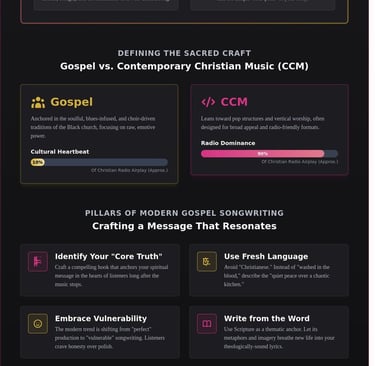
Many writers confuse Contemporary Christian Music (CCM) with Gospel, but the distinctions are vital. While CCM often leans toward pop structures and vertical worship, Gospel music remains anchored in the soulful, blues-infused, and choir-driven traditions of the Black church. Data from 2023 shows that while CCM dominates about 90% of Christian radio airplay, Gospel music continues to drive the cultural heartbeat of global worship through its raw, emotive power. Your "soul-print" is your greatest asset in this process. It's the specific way God's grace has intersected with your unique life story. You're a steward of a message meant for a specific audience who needs your exact perspective.
The Calling vs. The Career
A song can be a powerful ministry tool long before it ever becomes a commercial product. You might feel a divine nudge during a 3:00 AM prayer session or while driving to work. That's the start of your mandate. Excellence matters, but it shouldn't choke out authentic worship. In 2024, independent artists saw a 20% increase in streaming revenue; this proves you don't need a massive label to reach people if your calling is clear. Focus on being a steward first and a professional second. Strategy with soul means your profit never outpaces your peace.
Gospel Music in 2026: Trends and Timelessness
Looking ahead to 2026, gospel songwriting is incorporating R&B, Jazz, and even Folk elements more seamlessly than ever. The shift is moving away from "perfect" production toward "vulnerable" songwriting. Listeners in the digital age crave honesty over polish. Timeless truths about redemption haven't changed since the first hymns were penned, but they need fresh melodies to resonate with the 4.9 billion social media users worldwide who are looking for something real. You're building an emotional bridge between ancient scripture and modern struggles. Fresh sounds ensure the message doesn't get lost in the noise of a busy world.
The Foundation: Strategy with Soul in Your Composition
Composition isn't just about notes on a page; it's about intentional stewardship of a divine message. We often think the Holy Spirit only moves in the unplanned moments, yet a solid technical structure provides the necessary vessel for that flow. This is what I call "Strategy with Soul." Your hook must be more than a catchy phrase. It acts as the central truth that sticks in a listener's heart long after the music stops. Effective gospel songwriting requires you to move beyond the surface to find the "why" behind the melody.
Avoiding "Christianese" is your first step toward authenticity. While phrases like "washed in the blood" carry deep meaning, they can feel like static to a modern listener. Try finding fresh language for these ancient truths. Instead of saying you're "blessed," describe the quiet peace that settles over a chaotic kitchen at 6:00 AM. In a 2020 interview, we see Shawn James on Gospel's Influence as a raw, emotional force that connects with people regardless of their background. Building a melodic arc that mirrors your testimony creates a bridge between your story and the listener's struggle. When you seek clarity in your creative calling, you begin to see your songs as a legacy rather than just a temporary hobby.
Writing from the Word: Scriptural Alignment
Scripture is your greatest resource, serving as both a thematic anchor and a rhythmic guide. The 150 Psalms offer a masterclass in structure, moving from lament to praise with rhythmic precision. Don't just quote verses; let the metaphors of the Bible breathe. Use the imagery of the "widow's mite" or the "table in the wilderness" to paint a picture. Ensure your lyrics are theologically sound by checking them against the Word, but keep your poetry engaging enough to spark curiosity in the seeker.
Mastering the Song Structure (Verse, Chorus, Bridge)
The Verse: This is where you set the scene. Share the personal struggle or the specific situation that prompted the song. It’s the "before" in your testimony.
The Chorus: This is the universal truth. It should be the most singable part of the song, summarizing the core message in a way that a congregation or a car-full of people can shout together.
The Bridge: This serves as the "aha" moment. It provides a shift in perspective or a final surge of energy that completes the emotional journey.
Melodic Excellence and Chord Progressions
Gospel music thrives on the movement between tension and resolution. Use minor chords to represent the trials of life, then resolve into major keys to signify the hope found in Christ. Rhythm and "groove" are vital components; they provide the heartbeat that carries the lyrics forward. A melodic hook is the emotional anchor of a worship song that pulls a listener into a state of reflection through a recurring, memorable musical phrase. This balance of technical skill and spiritual sensitivity ensures your message is heard loud and clear.
Collaborative Stewardship: Why You Don't Have to Write Alone
Many creators feel a heavy weight, believing they must carry the entire creative burden to remain "authentic." You might ask yourself if the song is still your testimony if you didn't pen every single syllable. The answer is a resounding yes. Your song is a seed. While you provide the DNA of the story, a collaborator provides the soil and water to help it bloom. Data from the 2023 Gospel Music Association reports shows that over 85% of top-charting hits involved at least three credited writers. This isn't a sign of weakness; it's a commitment to excellence and a form of creative stewardship.
Scripture shows us that worship was never meant to be a solo act. The Book of Psalms contains 11 entries specifically attributed to the sons of Korah. These musicians worked in harmony with King David's vision to create a lasting legacy of praise. Collaboration is a biblical model. It allows different gifts to align for a single purpose. When you bring in a professional, they function as a midwife for your musical vision. They don't give birth to their own idea; they help you safely deliver yours. You retain the heart, while they provide the technical structure to ensure the message lands with clarity.
The legal side of gospel songwriting offers two primary paths for partnership. In a "work-for-hire" agreement, you pay a flat fee for a professional's services. You typically retain 100% of the ownership and royalties. In a traditional "co-writing" setup, you might pay a smaller fee or none at all, but you share the "back-end" ownership. Both paths are valid ways to honor your calling while respecting the craft of others.
When to Hire a Professional Gospel Songwriter
The "Singability" Gap: You have a powerful, life-changing testimony, but you struggle to condense those 20 years of grace into a three-minute lyrical structure that flows naturally.
Musical Roadblocks: You can hear the melody in your spirit, but you don't have the technical knowledge to map out the bridge or choose chords that evoke the right emotional response.
Professional Standards: You want to ensure your work meets the 100% technical readiness required for radio airplay or film licensing.
The Collaborative Process: What to Expect
The journey begins with a heart-to-heart session. This is where you share your testimony, your "why," and the specific scriptures that anchor your message. It's a time of spiritual alignment. Next, you move into the lyric and melody development phase. Here, the professional refines the phrasing for maximum impact, ensuring every word serves the central theme. Finally, you enter the feedback loop. This stage is vital because it ensures the final work still sounds like your voice. It's a process of pruning and polishing until the song reflects the peace and power of your original vision.
The 5-Step Process to Writing Your First Soul-Stirring Song
Effective gospel songwriting is an act of spiritual stewardship. It requires a blend of intentional strategy and raw vulnerability. You aren't just writing lyrics; you're building a bridge between a broken heart and a sovereign God. Clarity is your greatest tool. Follow these five steps to move from a blank page to a finished anthem that resonates with the soul.
Step 1: Identify your Core Truth. Choose one specific message. A 2023 analysis of the Billboard Gospel Airplay charts revealed that 92% of top-ranking songs focused on a single, clear scriptural promise. Don't try to say everything at once.
Step 2: Journal your testimony. Spend 20 minutes writing without stopping. Don't worry about rhyming or rhythm. Look for the raw, emotional gems in your personal walk with God. This is where the heart of the song lives.
Step 3: Develop the Chorus Hook. This is the anchor of your song. It's the part that people will sing in their cars and during their morning prayers. It must be the most memorable and emotionally resonant part of the composition.
Step 4: Map the structure. Organize your journaled thoughts into a logical flow. Use verses to build the narrative. Use a bridge to offer a fresh perspective or a climactic declaration of faith.
Step 5: Refine and Polish. Trim every word that doesn't serve the message. If a line doesn't point back to your Core Truth, it's fluff. Every syllable should have a purpose.
Overcoming Writer's Block with Purpose
When the words feel distant, use prayer and meditation as a creative reset button. Silence the noise of the world to hear the whisper of the Spirit. Ask yourself: "What did God do for me this week?" This simple prompt shifts your focus from performance to praise. Practice grace over hustle. It's okay to let a song breathe and develop over several weeks rather than forcing a finish in one sitting.
Testing Your Song for Congregational and Personal Impact
Success in gospel songwriting is measured by impact, not just production quality. Apply the hum-ability test. If a stranger can't remember the melody after one listen, simplify it. Use the heart test next. Does the song move you to tears or praise when you're singing it alone? Finally, seek feedback. Present your draft to three trusted ministry leaders to ensure the theology is sound before you move toward recording.
Your gift deserves a strategy that honors your calling and your peace. Start building your legacy with soul-centered guidance today.
Beyond the Page: Building a Legacy through Music Licensing
Your journey in gospel songwriting begins with a spark of inspiration, but it shouldn't end when the final note is written. True stewardship, or what we call 'Safárship,' involves treating your creative output as a sacred asset. You've been trusted with a message. Now, you must manage it with excellence. In 2023, the global music publishing market was valued at approximately $6.2 billion. Your songs are not just melodies; they are intellectual property that can support your ministry for decades. Protecting this work is vital. Registering your tracks with the U.S. Copyright Office and joining a Performance Rights Organization (PRO) like BMI ensures your rights are secured before your music reaches the ears of the world.
The Power of Synchronization (Sync) Licensing
Sync licensing is the process of pairing your music with visual media. Gospel music is currently in high demand for film and television because of its unique ability to convey hope, resilience, and deep emotion. A single placement in a major series or a documentary can generate between $1,500 and $20,000 in upfront fees. This revenue provides long-term financial support for your ministry, allowing you to record more music or serve your community. To succeed here, your gospel songwriting must be presented through high-quality professional demos. Music supervisors in 2024 rarely look at unpolished work. They need broadcast-ready files that prove your commitment to professional excellence.
Your Next Steps: Strategy with Soul
Building a legacy requires a blend of spiritual alignment and practical strategy. It's about moving from a place of "hoping to be heard" to "planning to be impactful." Marquita® specializes in helping artists bridge this gap. We believe that your business should serve your life, not the other way around. By focusing on "strategy with soul," we help you turn your creative vision into a licensed musical legacy that reflects your values and your faith. The world needs the message only you can write. Don't let your songs stay hidden in a notebook. Take the first step toward a sustainable, soul-led career today.
You have the calling. Now, let's build the framework to support it. You are invited to build a life and a legacy you love through the power of song. Peace and profit can coexist when you move with intention.
Ready to elevate your craft? Book a Custom Songwriting Consultation with Marquita and begin your journey toward a lasting musical legacy.
Your Message Deserves a Lasting Legacy
Your creative journey is more than a hobby; it’s a sacred assignment that requires both spiritual depth and professional precision. By embracing the 5-step process and the power of collaborative stewardship, you transform raw inspiration into a finished work that resonates. We’ve explored how gospel songwriting serves as a bridge between your personal testimony and a global audience. Whether you’re crafting your first soul-stirring melody or looking to navigate the world of music licensing for film and television, remember that your voice has a specific place in the kingdom. Independent gospel artist Marquita® Anthony founded this platform to help you bridge the gap between your vision and a professional, strategic reality.
You don't have to navigate the complexities of composition or industry standards alone. With a focus on soul-stirring melodies and strategic composition, we help you build an inheritance through your music. Let's Bring Your Vision to Life: Explore Custom Songwriting with Marquita®. Your songs are seeds of hope, and it’s time to see them bloom into a legacy that outlives the moment. May your creative process be filled with peace and your strategy be led by grace.
Frequently Asked Questions
Do I need to know how to read music to write a gospel song?
No, you don't need to read sheet music to be a powerful creator. About 70% of modern gospel creators rely on digital recording tools and their own ears to capture melodies. Your voice is your first instrument; use it to record voice memos that act as your musical shorthand until you collaborate with a producer who can transcribe your vision.
What is the difference between a hymn and a modern gospel song?
Hymns typically follow a strophic structure where every verse uses the same melody, much like the 1707 works of Isaac Watts. Modern gospel songwriting focuses on a dynamic Verse-Chorus-Bridge structure that allows for more vocal improvisation and emotional builds. This shift began in the 1920s with Thomas Dorsey, who blended traditional sacred lyrics with the rhythmic energy of blues and jazz.
How long does it typically take to write a professional-grade gospel song?
A professional song usually requires 15 to 25 hours of focused labor from the initial spark to the final polish. While a 3-hour co-writing session can produce a solid draft, the refinement process often takes another 14 days of prayerful editing. Mastery is found in the revision, ensuring every word serves the message and every note carries the weight of your testimony.
Can I use Bible verses directly in my lyrics without copyright issues?
It depends on the translation you choose for your lyrics. The King James Version is in the public domain, so you can use it freely without seeking permission. However, translations like the New International Version (1978) have specific limits; you can generally use up to 500 verses in a single work if they don't make up more than 25% of the total text.
Is it expensive to hire a professional gospel songwriter?
Hiring a professional usually costs between $500 and $3,000 depending on their experience and the project scope. Many seasoned writers offer work-for-hire agreements that allow you to keep 100% of the publishing rights for a flat fee. Investing in a pro is an act of stewardship, ensuring your message reaches the world with the highest level of musical excellence and professional clarity.
What should I do once my song is finished?
Register your work with the US Copyright Office and a performing rights organization like ASCAP or BMI. Once your legal foundation is set, record a high-quality demo to share with worship leaders or digital distributors. Protecting your intellectual property is a vital step in building a lasting legacy that honors your calling and your family's future.
How do I know if my song is 'good enough' for a church or audience?
Test your song's resonance by sharing it with a small group of 10 trusted peers or worship leaders. If 8 out of 10 people can hum the chorus after one hearing, you've created a melody that sticks. Spiritual impact is often measured by the "amen" in the room; look for that moment where the music fades and the message lingers in the heart.
What is a 'bridge' in a song and why is it so important in gospel music?
A bridge is a contrasting section that provides a new perspective or a peak of emotional intensity before the final chorus. In gospel songwriting, the bridge often serves as the "breakthrough" moment where the testimony reaches its climax. It usually appears around the 2 minute and 45 second mark, acting as a spiritual transition between the problem stated in the verses and the victory celebrated in the chorus.
Book Me for you Music needs!
We craft unique melodies and lyrics for you.
Music
MARQUITA HITMAKERS CONTACT
info@justmarquita
© 2025. All rights reserved.